It has long been a well-kept secret that among the many innovative and controversial
aspects of the original Macintosh design--such as bitmapped graphics, iconic
interfaces, and excessive disk swapping--was hardware capable of accessing subspace
fractal strings. Until now, there has been no system software means of accessing this
hardware. But with System 7.0 comes the Subspace Manager, an access path to the
underlying subspace transceiver available in every Macintosh. Now the truth can be
told--and this article tells it.
While the Macintosh was being designed, a small group of researchers at the Pacific
Alternative Reality Center discovered a simple means of accessing subspace. The
method they developed could be incorporated into virtually any integrated circuit,
requiring very little space. The Apple development team, aware of this work via
personal contacts with the group, decided to incorporate a subspace transceiver into
the IWM chip.
Almost from the first day, the decision to include a subspace facility was
controversial. Many thought that the device was simply a toy and would keep the
Macintosh from being accepted in the business market. Others felt that the device
might be dangerous and worried about getting UL approval. Still others were concerned
about adding yet another chapter toInside Macintosh.
In the end, a compromise was worked out: the hardware was included in the Macintosh,
but no means was provided to access it via the operating system. This allowed the
facility to be included in the spec sheet, but kept it from slowing down third-party
software developers. An early version of MacWrite used the facility to enable
interstellar collaborative editing, but the collaborative aspects were eliminated by
Marketing for being too far ahead of their time and thus confusing to users.
When the ASC chip was added to later Macintosh models, an improved subspace
transceiver was included. But once again, due to a slight management error--the
resources intended to be used to develop the Subspace Manager were instead used for a
four-day party in Monterey--no means of accessing the transceiver was made
available.
Finally, during the development of System 7.0, someone said, "Hell, we've got
everything else in it, why not add the Subspace Manager too." And so it was done.
Unfortunately, the contents page ofInside Macintosh Volume VI was frozen before a
chapter on the Subspace Manager could be added. This article takes the place of that
chapter.
The Subspace Manager is the part of the operating system that handles communication
between the application and the subspace transceiver in the IWM or ASC chip. The
Subspace Manager includes routines to access specific subspace dimensional strings
and transmission frequencies, subintegral dimensional storage, and the underlying
physical constants. Higher-level routines provide access to structured storage as
defined by Intragalactic Standards Organization (ISO) document
332.12.2234.2313.22.123a: Interspecies Data Standards , Subspace Storage and
Retrieval, Structured Formats, Access Methods, subsection J, revision 1822.
SUBSPACE AND FRACTAL STRINGS
To use the Subspace Manager properly, you need to understand what subspace is and
how fractal strings work.
The universe is composed of billions (and billions) of strings, all intricately
interwoven. Collectively these strings are known assubspace . Each individual string is
a zero-dimensional point fractally interwoven through the local space-time
continuum, bounded by mass concentrations (which distort the spatial geometry and
thereby contain the strings). Because a string has zero dimensions, the concept of
transit time across the string is meaningless. Because it's fractal, it achieves
connectivity with a large area in space.
Each fractal string has a unique fractal number that can be used to identify that
specific string. No other string can have exactly the same fractal dimension, as a
consequence of Boorman's conservation of dimensionality principle
(CoDP--pronounced "cod pee"). CoDP provides a convenient means of addressing a
particular string:
TYPE CoDPNumber = EXTENDED;
THE SUBSPACE TRANSCEIVER
The subspace transceiver in the Macintosh works by creating a subspace resonance
chamber, empty of any strings, and then "intruding" a length of a single string. The
influence on the string is directly proportional to the length of the string intruded.
Even though the lengths are measured in parsecs, the nature of fractal strings allows
the entire length to be intruded into a chamber that fits within a small part of an
integrated circuit.
Note: Observant readers will note that although strings are described as
zero-dimensional, we can also speak of the length of a portion of string. This is not the
contradiction it seems at first glance. However, the mathematics needed to illustrate
this fact are beyond the scope of this document.
Subspace string intrusion is commonly calledstring sucking in the technical
literature. This is the origin of the popular song "Suckin' in the Subspace," written
and originally performed by The Fracs. The (totally unsubstantiated) claim is made
that during the band's last performance of this song they hit precisely the right
frequency (just under F sharp) and were themselves sucked into subspace using no
more instrumentality than a poorly tuned guitar.
Warning: Don't try this with your Macintosh.
THE INTRAGALACTIC SUBSPACE ENCYCLOPEDIA
In an effort to share information with other species in the same gravitational
neighborhood, certain strings have been set aside as a community-access encyclopedia.
The format of the encyclopedia is defined by the ISO. Details of these standards are
available via the encyclopedia itself. The Subspace Manager includes a high-level
interface to the encyclopedia.
Warning: Members of some civilizations have decided not only not to contribute to
the encyclopedia, but also to actively disrupt it. These species make changes to existing
entries in the encyclopedia, rendering the content questionable and even dangerous. For
example, the entry on Earth was changed by one of these species to read "a mostly
harmless planet run by small white mice." Of course, Earth authorities immediately
changed it back to "a mostly harmless planet run by large multicolored apes."
This section describes the high-level Pascal interface to the Subspace Manager.
Because of space constraints, low-level Pascal routines are not described in this
article, but we're sure you can figure them out yourself.
FUNCTION SSInitialize (pi: EXTENDED; e: EXTENDED): OSErr;
SSInitialize initializes the hardware, evacuates the intrusion chamber, and tests the
local values of pi and e against those given. If pi and e do not match those of the local
reality, SSInitialize returns ssWrongReality; otherwise it returns noErr.
TRANSMITTING AND RECEIVING
FUNCTION SSTransmit (p: CoDPNumber; VAR count: LONGINT;
    buffPtr: Ptr):OSErr;
SSTransmit attempts to send the bytes found at buffPtr, of length count, via the set of
strings starting at p. It chooses a series of string numbers based on p, as needed to
contain the entire block of data. The algorithm for choosing the string number sequence
is defined in the ISO document. Besides being an accepted standard, the sequences are
chosen to maximize the string intrusion rate (the "suck"). Upon return, count reflects
the actual number of bytes transmitted.
FUNCTION SSReceive (p: CoDPNumber; VAR count: LONGINT;
    buffPtr: Ptr):OSErr;
SSReceive attempts to receive, from the strings starting at p, the number of bytes
specified by count, placing the received bytes in buffPtr. As with SSTransmit, a
sequence of string numbers is chosen based on the original p.
ACCESSING THE INTRAGALACTIC ENCYCLOPEDIA
FUNCTION SSEncycEntry (p: CoDPNumber; VAR entryTitle:
    Str255; VAR entry: Handle): OSErr;
SSEncycEntry attempts to retrieve the encyclopedia entry at string p. It places the
title of the entry into entryTitle and returns the contents of the entry in a handle. It is
the responsibility of the application to dispose of the entry handle when finished with
it.
All entries in the encyclopedia are written in the native language of the originators of
the encyclopedia concept--the Herbans. SSEncycEntry automatically translates
encyclopedia entries from Herbaneeze into English. However, the system can handle
only a limited subset of entries from the entire encyclopedia.
Note: No high-level access is provided to write new entries in the encyclopedia. If,
however, you must have write access to the encyclopedia, you can use the low-level
interface. This will require you to write an English-to-Herbaneeze translator. System
8.0 will include a bidirectional Herbaneeze translator as part of the Universal
Translator Package.
CHANGING REALITY
One of the many consequences of CoDP (the conservation of dimensionality principle)
is that each alternative reality has its own unique set of physical constants. In
addition, it follows directly from Malanthorpin's theorem of constant universality that
only two constants are needed to define a reality, because all other constants can be
derived from those two, and that any two constants are sufficient.
The Macintosh subspace transceiver has the ability to change the physical constants of
the current reality, thus moving the reality into a new Herzhold plane.
FUNCTION SSChangeReality (newPi: Extended; newE: Extended): OSErr;
SSChangeReality attempts to change the current reality's physical constants. If another
reality already exists with the new constants, SSChangeReality returns
ssRealityExists. If the reality change was successful, it returns noErr.
Changing the physical constants of reality almost always causes the destruction of all
life. To make sure that this is the real intent of the user, a new type of alert is
included with the Subspace Manager. The alert is invoked with the function
EndOfWorldAlert.
FUNCTION EndOfWorldAlert (alertID: INTEGER; filterProc: ProcPtr)
        :INTEGER;
This alert works the same as the StopAlert, NoteAlert, and CautionAlert functions,
except that it uses a different icon, as shown in Figure 1. Physical reality constants
should be changed only if the user clicks the OK button in the alert.

Figure 1 End-of-World Alert
This article has described the Subspace Manager available with System 7.0. This new
facility provides many powerful capabilities, and should result in many new and
exciting applications for the Macintosh.
The story is widely told that sometime in the last century, the legislature of Indiana
passed a law declaring that pi would henceforth be exactly 3, with the intent to
decrease the cost of teaching that portion of mathematics. This story is untrue: in fact,
the law was proposed but was defeated. If the Indiana legislature had only had a
Macintosh with a Subspace Manager, they could have actually succeeded in changing pi
to 3. And they may yet.
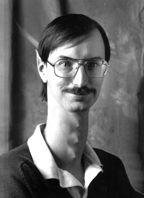
HARRY CHESLEY has had a fascination with subspace ever since discovering a
wormhole in his bathtub at age five. Spending much of his youth in subspace and his
college years as an exchange student on Pluto ("a real Mickey Mouse planet"), Harry
has relentlessly pursued the study of subspace, putting him in an ideal position to
write this article. Today he lives in subspace with his wife and daughter, and
commutes to Apple. *
The standard reference on subspace is Subspace Engineering--Theory and
Practice by MacMillon and Boorman (New York: Counterweight Press, 1957). The
reader may also be interested in Hummin' Beings, The Next Stage in Evolution by
Gregor Alman (Chicago: Omega Memes Press, 1997). In this book Alman argues that
creatures capable of directly influencing subspace string frequencies are the next
logical step in evolution. The fact that he completely misunderstands the concept of
evolution and that there are no examples of his so-called hummin' beings listed
anywhere in the Intragalactic Encyclopedia doesn't keep the book from being extremely
entertaining. *